
Carrying the Lessons of Chelyabinsk Forward


February 15, 2026
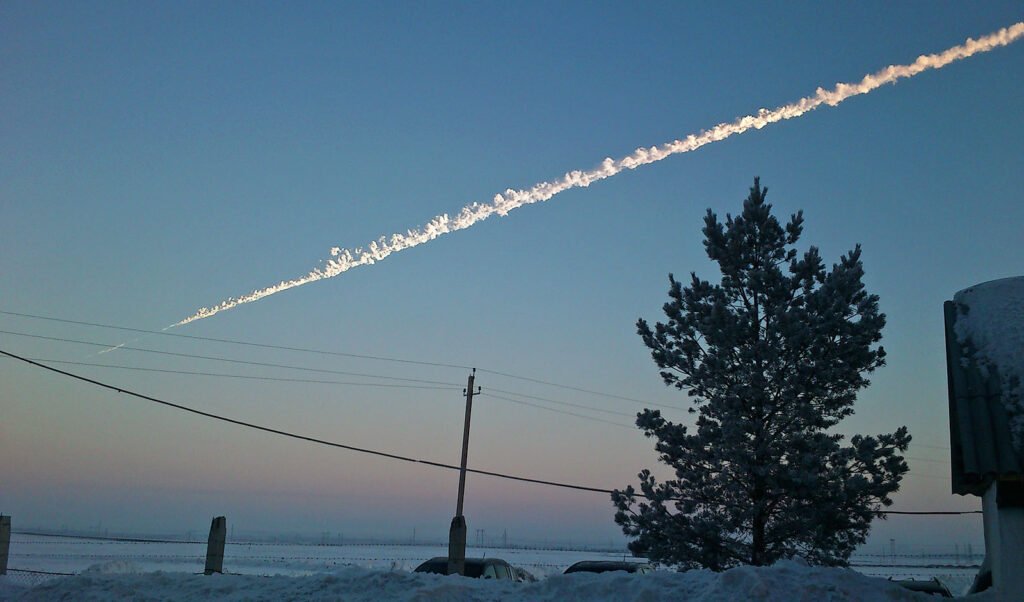
On February 15, 2013, a flash lit up the winter sky over Chelyabinsk, Russia. Thirteen years later, the lessons of that event continue to shape how the world approaches asteroid risk—and why sustained education and innovation in planetary defense remain essential.
That morning, a small asteroid about 20 meters wide entered Earth’s atmosphere traveling nearly 19 kilometers per second. It never reached the ground. Instead, it exploded high above the city, releasing energy equivalent to roughly 500 kilotons of TNT—about 30 times the power of the Hiroshima bomb. The resulting shockwave shattered windows across multiple cities, damaged more than 7,200 buildings, and injured approximately 1,500 people, mostly from flying glass. Captured on countless dashcams and witnessed by thousands, Chelyabinsk made asteroid impacts a visible and undeniable public-safety issue.
Before Chelyabinsk, many people imagined asteroid threats only in terms of rare, civilization-ending events. This airburst proved something critical: a city-scale asteroid can cause serious damage without ever hitting the ground. It was the largest atmospheric asteroid explosion since the 1908 Tunguska event—and a global wake-up call.
B612 had been sounding the alarm for years before Chelyabinsk, but it took a real-world event to bring planetary defense into the public conversation. In the month following the explosion, our cofounder, Dr. Ed Lu, testified before a U.S. Senate subcommittee on space-borne threats to humanity. In the years that followed, space agencies worldwide accelerated their efforts, including the creation of NASA’s Planetary Defense Coordination Office and new international coordination frameworks.
Today, B612 continues to expand our role in protecting our planet. Through the Asteroid Institute, we are developing modern tools for asteroid discovery, tracking, and visualization. Through education and outreach, we are preparing the next generation to tackle these challenges. The Schweickart Prize exemplifies this mission—its first winner proposed a novel approach to detecting sunward near-Earth objects, the same kind of hard-to-see asteroids responsible for Chelyabinsk. Programs like Asteroid Day and B612’s broader education initiatives ensure the public understands asteroid risks and the solutions within reach.
Chelyabinsk reminded us that planetary defense is not science fiction—it is a shared responsibility. B612 will continue advancing the education, innovation, and tools needed to better prepare us for the future.
—
Since 2002, B612 Foundation has engaged in research, education, and advocacy to advance our understanding of the solar system’s evolution, expand economic development in space, and protect our home planet from asteroid impacts.
Our progress is made possible by the generous contributions of our Leadership, Founding, and Asteroid Circle members, along with individual donors from 46 countries worldwide. Join our global community of supporters by making a donation today.