
New Paper Tackles Misinformation About Asteroid Impacts


August 27, 2026
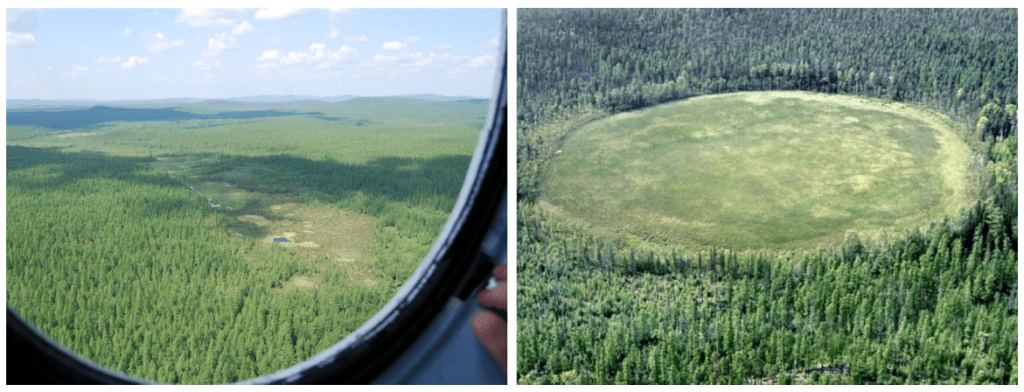 Left: The Tunguska epicenter, photographed by Mark Boslough in 2008. Right: A circular clearing about 25 km from the epicenter — frequently mistaken online for the “Tunguska crater,” but Tunguska was an airburst that left no impact crater at all. (Photo by Dmitry Efanov, 2004, courtesy of Tunguska Scientific Center.)
An asteroid the size of a bus can turn into a “civilization-ending” headline before anyone checks the math. A century-old airburst can spawn myths that outlive the scientists who study it. This is the reality of communicating about near-Earth objects in the internet age — and it’s exactly what a new paper takes on.
Mark Boslough and David Morrison, both members of the B612 community, are among the coauthors of Preventing and Correcting Spread of Misinformation About Near-Earth Objects, Impacts, Airbursts, and Planetary Defense: Case Studies, published this year in Meteoritics & Planetary Science. The paper walks through decades of asteroid-related misinformation — from panicked social media posts during the 2013 Chelyabinsk airburst, to persistent myths about the 1908 Tunguska event, to fringe theories that have somehow made their way into peer-reviewed journals. The authors sort these cases into three categories based on how fast they spread and how hard they are to correct: short-term news-cycle rumors, intermediate-term claims from poorly reviewed papers, and long-term “factoids” that stick around for generations.
The throughline is simple: public trust in planetary defense depends on getting the facts right, even when getting them wrong would be more exciting.
That’s a principle B612 has held since our founding. Long before “misinformation” was a buzzword, our mission was to help people understand the real risks and real science of asteroids — not the sensationalized version. That commitment hasn’t changed, and if anything, it matters more today than ever.
Since 2002, B612 Foundation has engaged in research, education, and advocacy to advance our understanding of the solar system’s evolution, expand economic development in space, and protect our home planet from asteroid impacts. Our progress is made possible by the generous contributions of our Leadership, Founding, and Asteroid Circle members, along with individual donors from 46 countries worldwide. Join our global community of supporters by making a donation today.