
Nothing Goes to Space by Accident


May 7, 2026
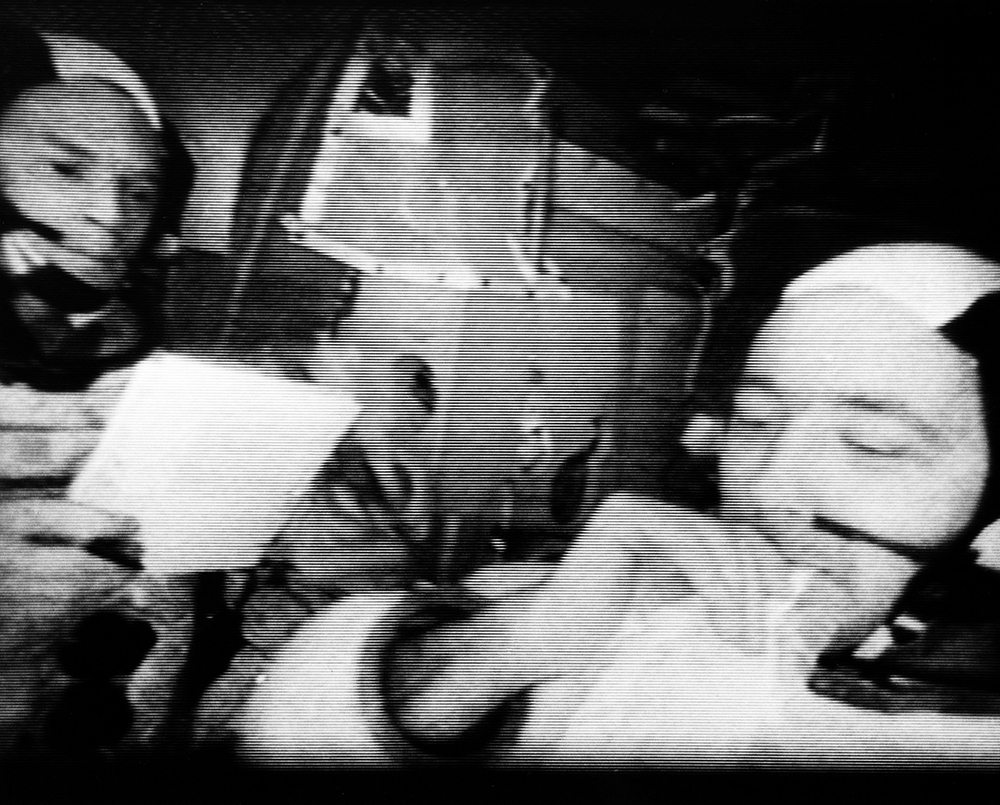 A live television image from the Apollo 9 mission showing the interior of the Lunar Module “Spider” while orbiting Earth in March 1969. Apollo 9 Commander James McDivitt appears in the foreground, with Lunar Module Pilot Rusty Schweickart visible in the background as the crew tested the Lunar Module in orbit. Photo Credit: NASA
Spaceflight leaves no room for excess. On missions like the Apollo 9 mission, every ounce was accounted for, every object scrutinized.
And yet, astronauts were permitted a small exception in the form of a Personal Preference Kit (PPK)—a limited set of personal items they could bring with them into orbit. These tokens were chosen not for utility, but for meaning. Flags, pins, medallions, and notes (among a myriad of other miscellany like tree seeds) were carried into orbit with intention, often meant to be shared, gifted, or preserved as part of the mission’s legacy.
Therefore, a flown item is defined not just by where it has been, but by the fact that it was chosen to go at all.
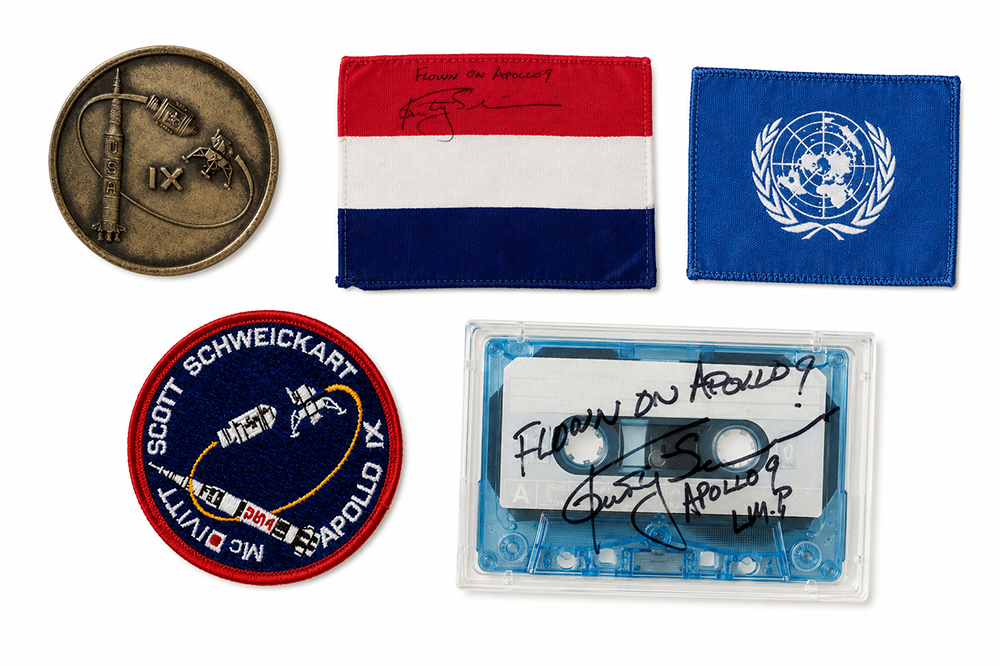
What Rusty Schweickart chose to carry aboard the Apollo 9 mission reflects both the magnitude of the Apollo mission and his personal mindset as a key actor in it.
Some items spoke to shared identity. Flags from the United States, Texas, the Netherlands, and a miniature Declaration of Independence connected the mission to place, partnership, and national purpose. Pins, coins, and patches—small symbols of a much greater effort—marked the program itself. Others carried a more personal layer of meaning. A United Nations flag reflected a broader view of the mission. As Schweickart put it, “For me, we were representing humanity going into space.”
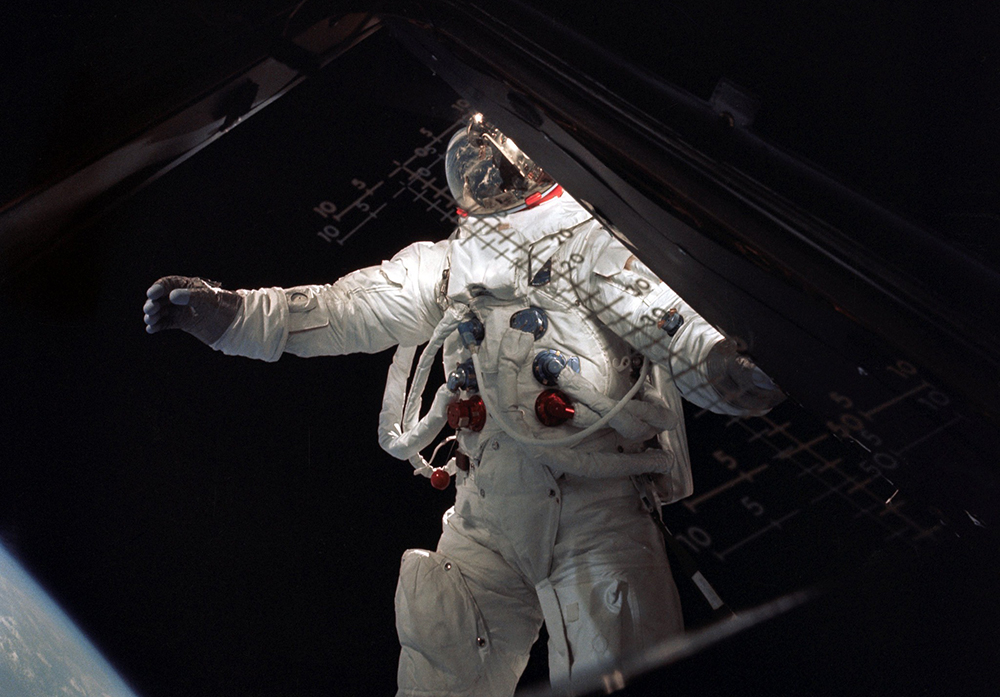 Apollo 9 astronaut Rusty Schweickart stands on the porch of the Lunar Module “Spider” during the mission’s historic spacewalk in Earth orbit, photographed from inside the Lunar Module by Commander James McDivitt. Credit: NASA
And then there were the items chosen for personal reflection. These included Rusty’s own mixtape of classical music. Apollo 9 was the first mission where astronauts were permitted to bring personal music into space, played on a portable cassette recorder intended for voice notes. Rusty selected Hodie, a cantata by Ralph Vaughan Williams, and Alan Hovhaness’s Mysterious Mountain symphony.
Famously, the tape went missing for much of the flight; whether by accident or at the hands of crewmates Dave Scott and Jim McDivitt, who were known to prefer country music, remains lost to history.
He also brought a set of handwritten quotes he described as “pretty impressive in terms of human wisdom”—including words from John F. Kennedy, the Bible, and even excerpts from the poem “How do I love thee?” from Elizabeth Barrett Browning. Some of these notecards were carried in his pocket during his historic EVA.
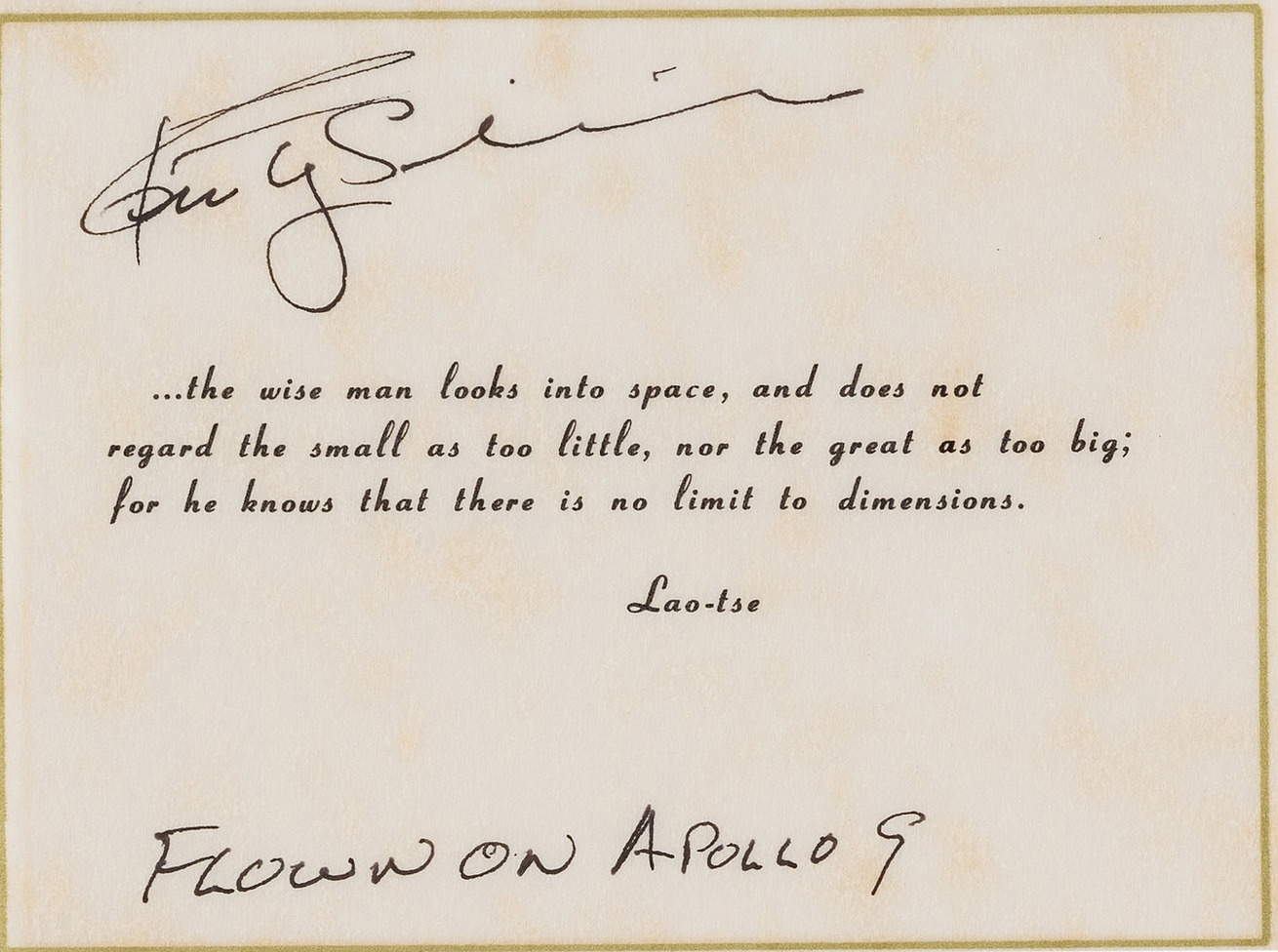 Before flying, Rusty had many of his favorite quotes printed on parchment. He carried them with him on the Apollo Mission, even stowing some in his pocket during his EVA.
None of these items was required for the mission. In a spacecraft engineered down to the ounce, they were among the few things carried for meaning alone. Together, they offer a rare glimpse into what was worth bringing: symbols of identity, gestures of diplomacy, and personal sources of reflection carried into an environment defined by precision and risk.
Over time, they have come to represent more than a single flight. Preserved for decades in Rusty Schweickart’s private collection, they now enter a new phase, offering a tangible connection to a perspective that continues to shape how we understand our place beyond Earth.
Rusty’s flown artifacts will be auctioned off in summer of 2026 with all proceeds going to support the Scheickart Prize.
A program of B612 Foundation, the Schweickart Prize is an annual award supporting the next generation of leaders in planetary defense and innovative ideas to help protect Earth from asteroid impacts. Each year, the winning student or team receives a museum-quality award featuring an authenticated meteorite, along with a $10,000 USD cash prize.
Click here for full details on the June/July 2026 auction and join our mailing list to receive the latest stories and insights from Annalise Schweickart as she explores the history and meaning behind her grandfather Rusty’s Space Collection.
 Annalise Schweickart, Ph.D.
Annalise Schweickart is a Postdoctoral Fellow at the Buck Institute for Research on Aging, using AI and computational methods to explore human longevity. She holds a Ph.D. in biological data science, specializing in metabolomic models for complex metabolic disease. Her commitment to protecting life on Earth runs in the family. As a granddaughter of Apollo 9 astronaut and co-founder of B612, Rusty Schweickart, Annalise carries that legacy forward through the Schweickart Prize, an annual award recognizing the next generation of graduate student leaders in planetary defense.