
Rusty Schweickart and a Life After Orbit


April 16, 2026
 Apollo 9 astronaut Rusty Schweickart stands in “golden slippers” on the Lunar Module porch looking at Earth on the fourth day of the Apollo 9 Earth-orbital mission. Photo Credit: NASA
What Rusty Schweickart chose to carry aboard the Apollo 9 mission reflects both the magnitude of the Apollo mission and his personal mindset as a key actor in it.
There is a moment, described by astronauts but rarely understood, when Earth stops feeling vast and begins to feel finite. In March 1969, Rusty Schweickart left Earth aboard the Apollo 9 mission and experienced exactly that.
“You realize that on that small spot, that little blue and white thing, is everything that means anything to you… all of it on that little spot out there that you can cover with your thumb.”
The Apollo 9 mission was a proving ground, testing the Lunar Module and refining the systems that eventually brought humans to the moon. During the mission, Rusty left the spacecraft using a self-contained life support system, working untethered in space.
Suspended in the silence of orbit, Rusty gained a new appreciation for the fragility and shared responsibility that is our home here on Earth. This perspective became the foundation for a decades-long effort to safeguard this planet.
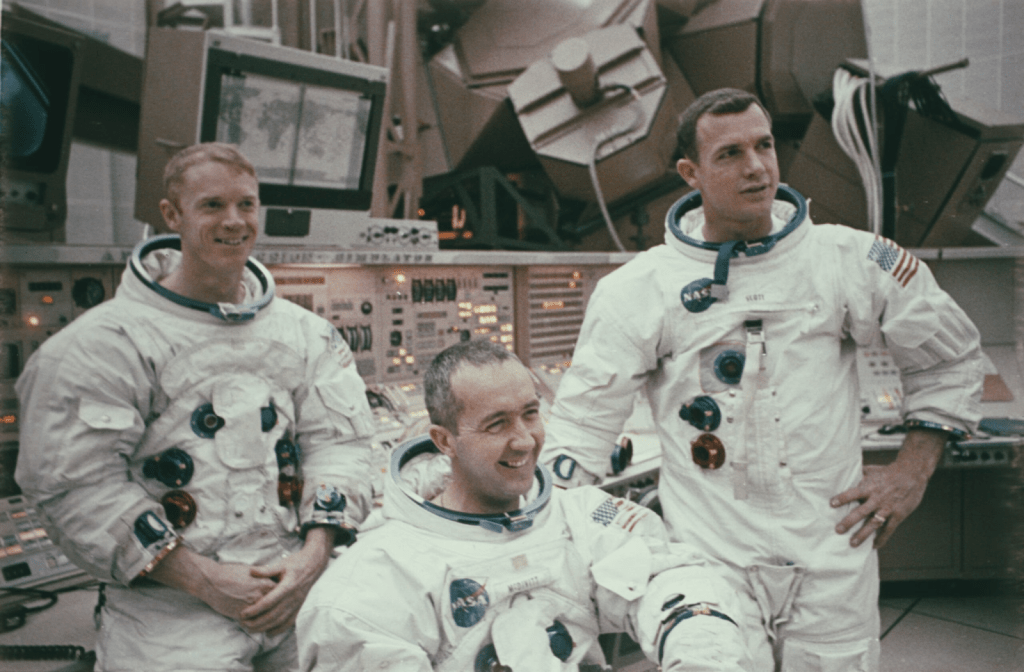
In the years that followed, his work expanded beyond exploration into coordination, as he brought together the people and institutions needed to think about space as a shared domain. In 1985, he founded the Association of Space Explorers, uniting astronauts and cosmonauts from around the world. A decade later, his work took him to Russia and the former Soviet Union as a U.S. delegate to the World Radiocommunication Conferences, helping shape international collaboration in space and communications.
By the early 2000s, that focus sharpened. In 2002, he co-founded the B612 Foundation, with a clear objective: to detect, track, and ultimately deflect asteroids that could threaten Earth.
His efforts extended into global policy. As chair of the United Nations ASE Near-Earth Object Committee, he led the development of the 2008 report Asteroid Threats: A Call for Global Response, one of the first coordinated frameworks for planetary defense. In 2014, he co-founded Asteroid Day, a United Nations-sanctioned initiative to raise awareness of impact risks worldwide.
What began as a shift in perspective had become something more structured: a sustained effort to understand and ultimately reduce the vulnerabilities of the planet itself.
Now, Rusty is shaping what he intends to leave behind. Objects from Rusty Schweickart’s private collection are being made available, the proceeds directly supporting his legacy in planetary defense through the Schweickart Prize.
A program of B612 Foundation, the Schweickart Prize is an annual award supporting the next generation of leaders in planetary defense and innovative ideas to help protect Earth from asteroid impacts. Each year, the winning student or team receives a museum-quality award featuring an authenticated meteorite, along with a $10,000 USD cash prize.
Click here for full details on the June/July 2026 auction and join our mailing list to receive the latest stories and insights from Annalise Schweickart as she explores the history and meaning behind her grandfather Rusty’s Space Collection.
 Annalise Schweickart, Ph.D.
Annalise Schweickart is a Postdoctoral Fellow at the Buck Institute for Research on Aging, using AI and computational methods to explore human longevity. She holds a Ph.D. in biological data science, specializing in metabolomic models for complex metabolic disease. Her commitment to protecting life on Earth runs in the family. As a granddaughter of Apollo 9 astronaut and co-founder of B612, Rusty Schweickart, Annalise carries that legacy forward through the Schweickart Prize, an annual award recognizing the next generation of graduate student leaders in planetary defense.