

The Paperwork That Took Us to the Moon


May 19, 2026
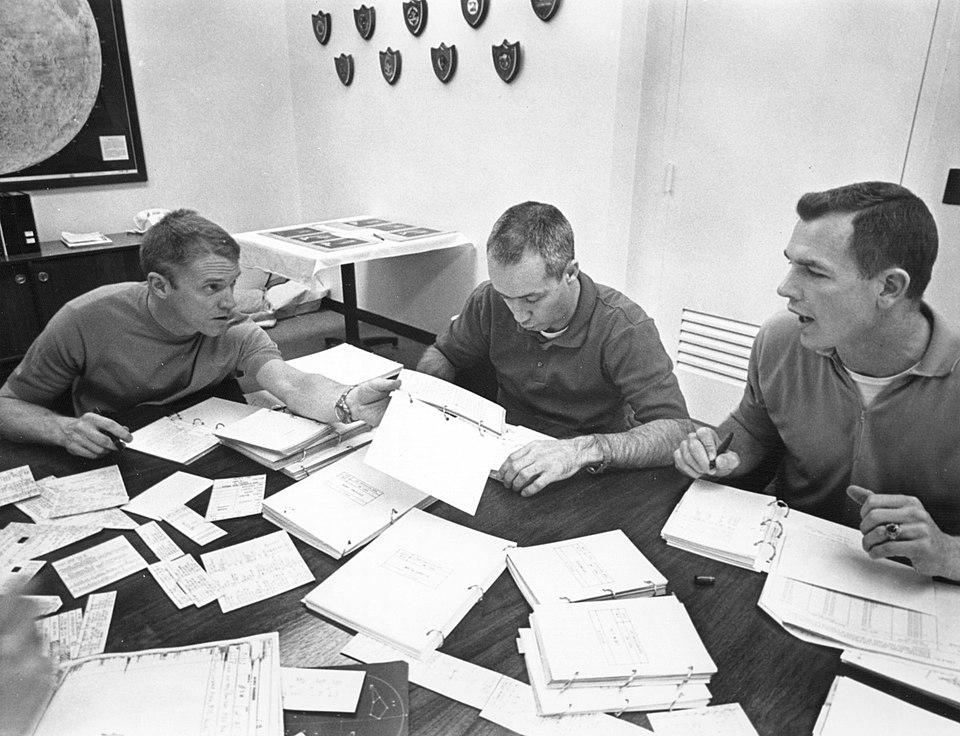 26 Feb 1969. Apollo 9 astronauts Russell L. Schweickart, James A. McDivitt, and David R. Scott, compare notes on flight plan for earth orbital mission to test lunar module spacecraft. Credit: NASA
When people imagine Apollo, they picture launches, moonwalks, and astronauts in white suits. What they rarely picture are the three-ring binders: the flight plans, docking procedures, shift-change transcripts, checklists, and press kits that formed the working architecture allowing humans to leave Earth, operate in space, and return safely home.
What in their time were operational tools, these documents have now become a record of the Apollo project before it became mythology. The transcripts capture conversations as they unfolded. The manuals preserve the exact procedures astronauts trained on. They preserve the decisions, procedures, conversations, and contingencies behind one of the most ambitious engineering efforts in human history.
More than half a century later, they remain essential records of that work. Asked about specific operational details of the Apollo 9 mission, like how many cameras were on board, even Rusty Schweickart relies on the checklists themselves: “You could go to the checklist and find out how many we had,” he told me in a recent conversation.
 This signed transcript captures the full proceedings of the Apollo 9 Pre-Flight Press Conference, held on March 2 1969 prior to the mission’s launch. The conference featured detailed briefings from NASA officials. Imaged by Heritage Auctions, HA.com.
One document in the collection captures a moment of uncertainty just days before the Apollo 9 launch. The signed transcript of the Apollo 9 mission Pre-Flight Press Conference, held on March 2, 1969, opens not with triumph, but with medical updates. The mission had been delayed from its original February 28th launch window to March 3rd because, according to Rusty Schweickart, “the doctor said we had reddened throats.” While “reddened throats” may not be a cause for concern here on earth, bringing sickness into space was a major risk when no medical care would be available. This risk is clear in this press conference document: the first speaker listed in the transcript is Dr. Charles Berry, NASA’s Director of Medical Research and Operations, reflecting just how seriously even minor illness was treated before flight.
It is a small detail, but an important one. These documents preserve the Apollo 9 mission’s lived reality: technical, procedural, and occasionally dependent on whether three astronauts woke up healthy enough to fly.
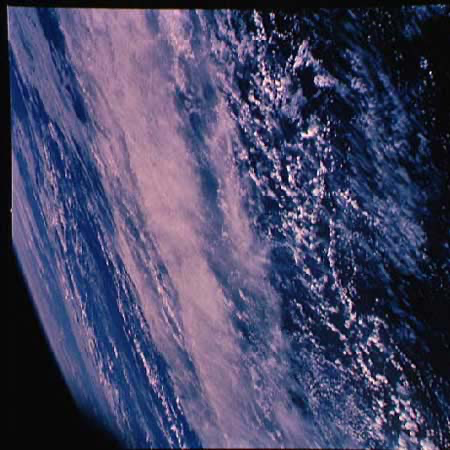 Image taken on the Apollo 9 mission described as “Ocean, clouds, off California in the signed Photo Frame Register in the Schweickart Auction collection. Credit: LPI.usra.edu
One of the more deceptively technical items in the collection is the Apollo 9 mission Photo Frame Register: a detailed log documenting photographs taken during the mission. Every image was cataloged by frame number alongside area descriptions and mission metadata, preserving a precise record of what the crew photographed while orbiting Earth.
While one might imagine majestic views of the Earth to be riveting reading material, some of the register entries feel strangely mundane: “Arizona: mostly clouds.” “Arizona, New Mexico: mostly clouds.” “New Mexico, Texas: mostly clouds.” But that plainness is part of what makes the document remarkable. It was never intended to glorify the Apollo missions; it was created simply to document the mission as it unfolded.
Behind the register itself is a more human story. When asked whether the photography was automated, Rusty Schweickart was quick to clarify: “No, no, they’re all taken by hand.” The crew carried Hasselblad 70mm cameras and photographed both the assigned mission targets and scenes they chose themselves.
One such assignment came from a colleague in NASA’s photo lab who wanted an image of the Grand Canyon for an article in Arizona Highways magazine. Schweickart recalled preparing carefully for the pass over Arizona, only to discover that under the direct overhead sunlight, he could barely distinguish the canyon itself. “I pointed where it should be, and I took the picture,” he remembered. After the mission, his colleague confirmed the result: “Perfect, right in the middle of the frame.”
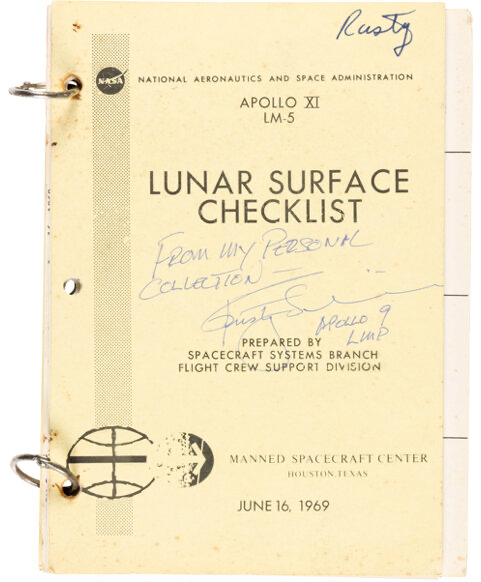 This signed checklist booklet provided Apollo 11 astronauts with detailed procedures and reference information for activities conducted on the lunar surface. It will be listed as part of the Schweickart Auction. Imaged by Heritage Auctions, HA.com.
Among the most revealing documents in the collection are the signed technical crew debriefings of the Skylab missions that followed one of NASA’s most dramatic near-failures. When Skylab launched in May 1973, the station was severely damaged during ascent. Its micrometeoroid shield tore away from the workshop, ripping off one solar array and jamming the other closed. The loss of the shield also exposed the station to intense solar heating, threatening to render Skylab uninhabitable before a crew had ever entered it.
Although not part of the flight crew itself, Rusty Schweickart played a major role in the emergency response as backup commander for the first crewed Skylab mission. He helped lead the rapid development of the hardware and procedures used to deploy an improvised thermal shield and free the jammed solar array. These repairs ultimately saved the station.
The debriefings preserve the operational aftermath of that effort in extraordinary detail, but also reveal a side of Schweickart’s legacy that extends beyond Apollo itself. Beyond the exploration, there was problem-solving, coordination, and technical leadership required to sustain human spaceflight after the first missions captured the world’s attention.
Long before the missions of the Apollo program became legend, they existed as procedure. These documents preserve the space age in its present tense; they preserve the technical language, decisions, uncertainties, and coordination that transformed exploration from ambition into reality.
Documents from Rusty’s private collection will be auctioned off in the summer of 2026, with all proceeds going to support the Scheickart Prize.
A program of B612 Foundation, the Schweickart Prize is an annual award supporting the next generation of leaders in planetary defense and innovative ideas to help protect Earth from asteroid impacts. Each year, the winning student or team receives a museum-quality award featuring an authenticated meteorite, along with a $10,000 USD cash prize.
Click here for full details on the June/July 2026 auction and join our mailing list to receive the latest stories and insights from Annalise Schweickart as she explores the history and meaning behind her grandfather Rusty’s Space Collection.
 Annalise Schweickart, Ph.D.
Annalise Schweickart is a Postdoctoral Fellow at the Buck Institute for Research on Aging, using AI and computational methods to explore human longevity. She holds a Ph.D. in biological data science, specializing in metabolomic models for complex metabolic disease. Her commitment to protecting life on Earth runs in the family. As a granddaughter of Apollo 9 astronaut and co-founder of B612, Rusty Schweickart, Annalise carries that legacy forward through the Schweickart Prize, an annual award recognizing the next generation of graduate student leaders in planetary defense.