
Asteroid Day 2026: Rubin Officially Begins Operations


June 30, 2026
This morning, Zeljko Ivezic, LSST Project Scientist, told me that the Vera C. Rubin Observatory had begun operations. I cried.
Ten years ago, in the spring of 2016, I handed Zeljko a vision paper in an airport as we were flying to Meteor Crater. It laid out a plan for the Asteroid Institute and a computational platform we would come to call ADAM, a future that did not yet exist, built around a telescope still years from completion. We were on our way to the most famous impact site on Earth, carrying a plan to find the next one before it found us.
Today, June 30, 2026, on Asteroid Day, that telescope formally began its Legacy Survey of Space and Time, the most powerful solar system discovery machine ever built (read NOIRLab’s announcement). The person I handed that document to is the one who told me it had come true.
This is not really a B612 story, or a story about any one of us. It is a celebration for humankind. For the first time, we have a machine capable of finding the asteroids that have shared our solar system and threatened our planet, for as long as there has been a planet to threaten. That changes what our species is able to see and to prepare for.
When we helped launch Asteroid Day in December 2014, its centerpiece was the 100X Declaration: a call to accelerate near-Earth asteroid discovery a hundred-fold, to 100,000 per year. It was deliberately aspirational. No telescope then operating could come close. It would take a fundamentally different machine.
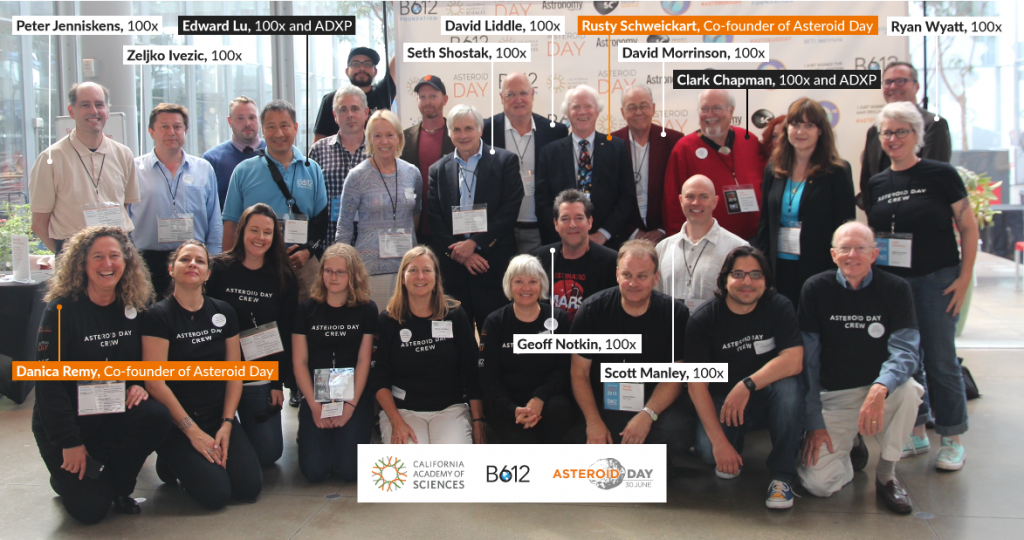
That machine, then called LSST, was already taking shape, and the scientists building it were part of our community from the start. On June 30, 2015, at the very first Asteroid Day at the California Academy of Sciences, LSST Project Scientist Zeljko Ivezic gave a talk titled “Hunting for Asteroids with LSST,” calling it an “amazing discovery machine for new asteroids.” Alongside him, Mario Juric, who represented LSST at Asteroid Day Live in 2017, and Andrew Connolly at the University of Washington, all three of them and others spent decades turning the survey from proposal into reality.
Rubin produces the observations. What it cannot do on its own is computationally recover, link, and refine the orbits hidden in that flood of data. That is the work we built our ADAM platform to do: hosting astronomical datasets and running algorithmic discovery that has already surfaced tens of thousands of asteroids from archival data others had overlooked. As new batches arrive, we are publishing the exports of the observations taken by the Vera C. Rubin Observatory (observatory code X05) that were submitted to the Minor Planet Center, making them openly available to researchers everywhere.
This is a true collaboration, and we are thrilled to keep advancing it. Rubin will deliver millions of observations; we will help turn them into the asteroids we set out to find. Together, the 100X goal we declared a decade ago is finally within reach.
None of this would be possible without our donors. For more than a decade, you believed in this work before there was a discovery machine on a mountaintop to point to, before “ready” meant anything concrete. Your generosity is the reason B612 stands prepared today to use and extend Rubin’s data, and to help the world discover and track asteroids in near real time. From all of us, thank you. This milestone is yours too.
Explore the data and tools at b612.ai, and learn more about the Asteroid Institute at b612foundation.org.
About Danica Remy:
 Danica serves as President of the B612 Foundation, which leads the private sector efforts in research, analysis and systems design to protect Earth from asteroids. Danica also co-founded the international program, Asteroid Day which is supported by the Government of Luxembourg and international space agencies and satellite companies. In 2016 it was sanctioned by the United Nations as an official day to increase global awareness and education of asteroids. The other co-founders are legendary Queen guitarist Dr Brian May, Apollo 9 astronaut Rusty Schweickart, and German filmmaker Grigorij Richters.