
Asteroid Institute | Faster ADAM::Precovery, Built for Rubin


August 27, 2026
The Asteroid Institute has upgraded Precovery, the Asteroid Discovery Analysis and Mapping (ADAM) platform service that searches astronomical archives for detections that have not yet been linked to an asteroid—before or after its discovery. It now runs far faster, returns more complete search results, and is designed to handle the volume and cadence of data from the Vera C. Rubin Observatory. By making more observations available for orbit fitting, it can significantly improve our ability to predict where solar system objects will be in the future.
Why a more precise orbit matters
Discovering an asteroid does not mean that we immediately know precisely where it will be in the future. An orbit calculated from a short span of observations can still represent a wide range of possible future positions. Finding additional observations, particularly observations separated by longer periods of time, can narrow that range considerably.
For planetary defense, a tighter orbit refines estimates of whether, when, and where an object could impact Earth. If intervention were necessary, those estimates would help determine how much warning time was available and how much the object’s trajectory would need to change for a deflection.
Orbit precision also matters for scientific and commercial missions. Many near-Earth objects have orbits that are sufficient to identify and track them, but not precise enough for spacecraft targeting. A tighter orbit gives mission planners a better estimate of where a potential target will be and how uncertainty could affect the trajectory needed to reach it.
A recent search for the near-Earth asteroid 2026 PG provides a concrete example of how observations already present in an archive can change that picture.
Finding earlier observations in Rubin data
2026 PG is a near-Earth asteroid first reported by Pan-STARRS 2 at Haleakalā on August 3, 2026. At the time of this analysis, the observations linked to it by the Minor Planet Center covered 4.64 days. This span of observations is known as the asteroid’s observational arc.
Precovery compared the asteroid’s orbit and its uncertainty with approximately 11.5 billion historical observations. In less than five minutes, it returned four possible matches in the Rubin alert stream from June 30, more than a month before the asteroid’s currently linked observations began.
If independently validated and accepted, the Rubin detections would extend the beginning of the observational arc by 34.17 days, increasing its total duration to 38.81 days—more than eight times as long.
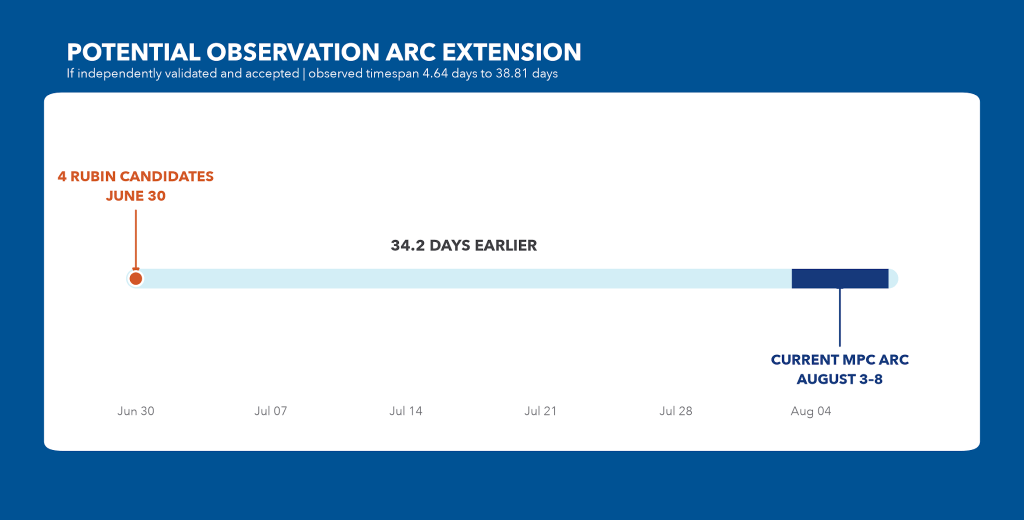 Figure 1. If independently validated and accepted, the four June 30 Rubin detections would move the beginning of the observational arc about 34.2 days earlier and increase its duration from 4.6 to 38.8 days.
An asteroid’s orbit is calculated from where it was observed at specific times. A longer span of observations gives that calculation more leverage, making it easier to distinguish between possible orbits that fit a short set of observations.
The effect is easiest to see by comparing the asteroid’s predicted position 30 days later. The large blue ellipse in Figure 2 shows the formal uncertainty region based on the existing Minor Planet Center observations. The considerably smaller orange ellipse shows the corresponding region after adding the Rubin candidate detections.
The longest dimension of the region falls from 96.6 to 5.0 arcseconds, a reduction of 94.8 percent. The total area of the ellipse is reduced by 99.27 percent. This provides a substantially more precise estimate of where the asteroid will be on the sky.
 Figure 2. Formal on-sky positional uncertainty 30 days after the final observation. Adding the Rubin candidate detections reduces the three-sigma major axis from 96.6 to 5.0 arcseconds and the area of the uncertainty ellipse by 99.27 percent. The orbit fits were performed with adam-core and ASSIST. These are model-dependent formal estimates rather than calibrated confidence regions.
Missed by original Precovery
The four Rubin candidates were about 35.8 arcseconds from the asteroid’s nominal predicted position. The original Precovery service used a fixed search radius of 10 arcseconds, so it would not have returned them. The upgraded service searches the changing uncertainty region around the predicted position instead of imposing the original fixed cutoff.
The offset of 35.8 arcseconds was still consistent with the uncertainty in the asteroid’s short orbit. Once that uncertainty was taken into account, the candidates were approximately 1.7 sigma from the prediction and well within a plausible distance.
Built for Rubin scale
The change in search behavior is one part of a broader upgrade. The original Precovery service could search large astronomical archives, but now performs those searches faster and at the scale Rubin’s nightly alert stream will demand. Rubin is expected to produce millions of time-stamped detections each night, creating a rapidly growing record of possible observations of solar system objects.
To handle that volume, we store our observation catalogs in optimized and partitioned files on Google Cloud Storage and fetch them dynamically for each search. Google BigQuery stores complementary information, including whether the Minor Planet Center has already attributed an individual detection to a known object.
Precovery now includes data from the Rubin Alert Stream, Asteroid Terrestrial-impact Last Alert System, Zwicky Transient Facility, the NOIRLab Source Catalog, SkyMapper, and the Minor Planet Center’s entire observation database.
A public service for the Rubin era
Precovery is publicly available now through ADAM at https://b612.ai/adam. Researchers can submit an orbit and its uncertainty, search the catalog, and compare known observations against possible new matches — no need to build search infrastructure of your own. You’ll need a free ADAM account to get started; for larger-scale or programmatic access, contact us.
Rubin’s alert stream will add large numbers of observations to that archive. Some will be linked immediately to known objects. Others may become useful only after an asteroid is discovered or its orbit improves. Precovery is built to search that growing record and find those connections when they become possible.
Other ADAM Services
Precovery is one of four astrodynamics services available on ADAM, alongside ADAM::Ephemeris, ADAM::Impact Probability, and ADAM::Trajectory Optimizer. All four run on Google Cloud and share the same open-source adam-core foundation.
 Alec Koumjian is the Head of Software Engineering, leading project and engineering management to develop a comprehensive suite of astronomy software services. With over a decade of experience in large-scale software engineering projects, he holds a bachelor’s degree in physics and computer science from Marlboro College, Vermont.
Asteroid Institute brings together scientists, researchers, and engineers to develop tools and technologies to understand, map, and navigate our solar system. A program of B612 Foundation, the Asteroid Institute leverages advances in computer science, instrumentation, and astronomy to find and track asteroids. Join our global community of supporters and make a donation today.