
Asteroid Institute Contributions to Early Rubin Asteroid Research


January 9, 2026
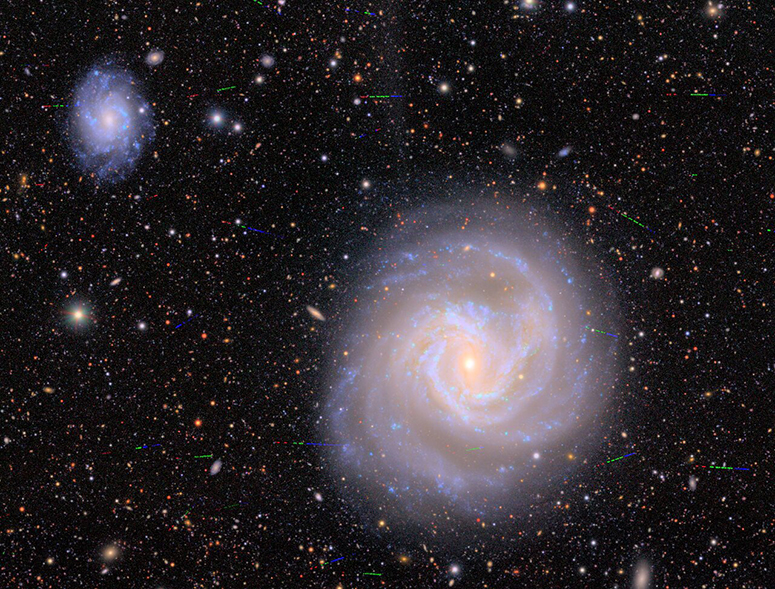 Asteroids streak across this Rubin Observatory image of the Virgo Cluster, visible as tri-colored trails created by their motion across repeated exposures. Credit: RubinObs/NOIRLab/SLAC/NSF/DOE/AURA
Several current and former members of the Asteroid Institute team contributed to research published in The Astrophysical Journal Letters examining early asteroid discoveries from the Vera C. Rubin Observatory. This work reflects years of sustained investment in building and supporting the people behind this research.
The paper features contributions from a cross-section of the Asteroid Institute’s history. Lead author Sarah Greenstreet was among our inaugural Asteroid Institute Fellows in 2018. The author group also includes our most recent Fellow, Joachim Moeyens, as well as our Head of Software Engineering, Alec Koumjian, highlighting the continuity of expertise that underpins our work.
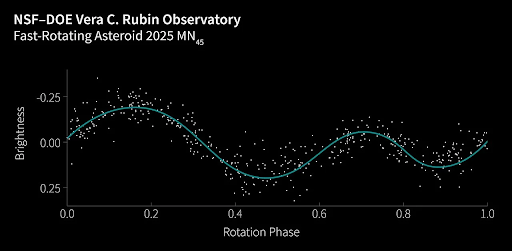 Credit: NSF–DOE Vera C. Rubin Observatory/NOIRLab/SLAC/AURA/J. PollardAcknowledgement: PI: Sarah Greenstreet (NSF NOIRLab/Rubin Observatory)
This research focuses on the early characterization of asteroids detected by the Rubin Observatory, examining how initial observations can be used to determine key properties such as orbital behavior, rotation rates, and physical structure. As part of their analysis, the authors used the Asteroid Institute BigQuery replica hosted on the ADAM platform to retrieve, organize, and analyze all observations associated with Rubin’s newly discovered asteroids as a single, structured dataset. This kind of early analysis is critical for understanding the small-body population of our solar system and for preparing discovery pipelines ahead of Rubin’s full survey operations.
As the observatory comes fully online, the Asteroid Institute continues to strengthen ADAM (Asteroid Discovery Analysis and Mapping) platform with new tools that help translate these vast data streams into scientific insight.
The paper has already attracted external attention, including coverage from Popular Science.
Asteroid Institute’s contribution to this research was made possible by the generous support of our donors, especially our Leadership Circle members acknowledged in the paper.
Read the Popular Science coverage.
View the research paper (ApJ Letters).
—
A program of B612 Foundation, Asteroid Institute brings together scientists, researchers, and engineers to develop tools and technologies to understand, map, and navigate our solar system. Join our global community of supporters by making a donation today.